The average customer is a person who doesn't exist
The Field Guide · No. 3

In 1950 the US Air Force had a problem it couldn't explain. Its planes were coming down at a rate nobody could account for, not in ones and twos but often enough that on a bad day a couple of dozen aircraft would be lost across the country, and the machines themselves kept checking out fine. Engineers went over the mechanics and the electronics and found nothing wrong. The obvious remaining suspect was the men in the seats, so the crash reports leaned on pilot error, except these were some of the best-trained pilots in the world and they were as baffled as anyone.
Eventually someone looked properly at the cockpit. It had been built, dimensionally, around the average pilot, using measurements taken back in 1926, and the working theory became that the average had simply gone out of date, that pilots had got bigger or the old numbers were rough, and what the situation called for was a fresh and more accurate average. So they measured 4,063 pilots across 140 dimensions, everything from height and chest circumference down to the distance between a man's eye and his ear, and set about recalculating the standard airman.
One of the people doing the measuring was a 23-year-old researcher called Gilbert Daniels, who had studied physical anthropology and spent part of his time at Harvard measuring the hands of a few hundred classmates, where he'd noticed something that stayed with him, which was that when you averaged all those hands together the average hand didn't match anybody's actual hand. So while the rest of the lab worked toward a better average pilot, Daniels was quietly turning over a different question, whether the average pilot existed at all.
What Daniels found
He took the ten dimensions thought to matter most for cockpit design and defined "average" about as generously as anyone reasonably could, counting a pilot as average on a given dimension if he landed inside the middle 30 per cent of the range. Average height came out at five foot nine, so anyone from roughly five-seven to five-eleven still counted, which is a deliberately wide band. Then he went through all 4,063 men and counted how many sat inside that band on all ten dimensions at once.
When he tabulated it, the answer was none: out of 4,063 pilots, not one fell within the average range on all ten dimensions. And it gets worse, or more interesting, depending how you feel about being wrong, because even if you dropped from ten dimensions down to three, fewer than 3.5 per cent of the men qualified as average across all three. The figure the whole cockpit had been built around described no living person in the entire air force. What makes that sting a little more is that these pilots had already been pre-selected for their size to fit the existing planes, so this was the population most likely to contain an average man, and it still contained none.
The fix, once the finding was accepted, was almost embarrassingly plain. Stop building the plane for a man who isn't there and build it to move instead, a seat that slides and pedals that come to the leg rather than the leg stretching for the pedals, plus straps and helmets that move to fit whoever is actually in them, the same logic that's now so ordinary in a car you'd never think to call it an insight. Accident rates dropped and performance went up, and the whole expensive hunt for a more accurate average turned out to have been the wrong errand from the start.
We do exactly this with people
Here is the part that should make any of us who've ever run a persona workshop a bit uncomfortable. The composite persona is the average pilot. You gather your interview notes and your tickets and whatever the last survey said, you find the centre of it, and you write down Sarah, 34, operations lead at a mid-market company, time-poor, a little sceptical of yet another tool, lives in spreadsheets. Every clause in that is defensible on its own, and that is precisely the trouble, because each clause has been averaged separately and then stacked into one figure who, the moment you assemble her, almost certainly matches nobody in the research you started from.
The real people behind it are what a researcher would call jagged. One of them is exactly your age guess and nothing like your seniority guess, another fits the job and the scepticism but is twenty years older with a team of forty under her, and the person who's bang on the average for tenure turns out to be an outlier on company size, so that no single human you actually spoke to is Sarah. She's real in the way the average pilot was real, an accurate description of the group and a faithful likeness of nobody in it, which is a strange thing to hang a roadmap on.
The part you can't see
What's actually dangerous here isn't that the persona is fictional. Everyone knows the persona is a model, and a model being simplified is sort of the whole point of having one. The danger is that the averaging doesn't only blur the people, it quietly deletes the spread, and the spread is usually where the real product decisions are living. Flatten a range into a midpoint and you lose the fact that your users split into two quite different groups who want opposite things, and you end up shipping a compromise aimed at the gap between them, a cockpit sized for the pilot in the middle. The compromise feels reasonable in the room, and it goes on feeling reasonable right up until you notice it fits nobody especially well, except by then the people it fits worst have usually gone quiet or gone elsewhere, without ever quite telling you why.
I think this is one of the quieter reasons good teams ship things that test fine in the room and then land flat out in the world. It usually isn't that the research was bad so much as that somewhere between the raw conversations and the clean doc the variance got smoothed away, and the variance was the part that would have told you what to build.
What adjustable looks like here
I don't think the move is to throw personas out, which would be its own overcorrection, and a persona is genuinely useful as a way of carrying a messy group around in your head. It's closer to what the air force did once it stopped arguing about the average, which was to quit treating the centre as the target and start designing for the range around it.
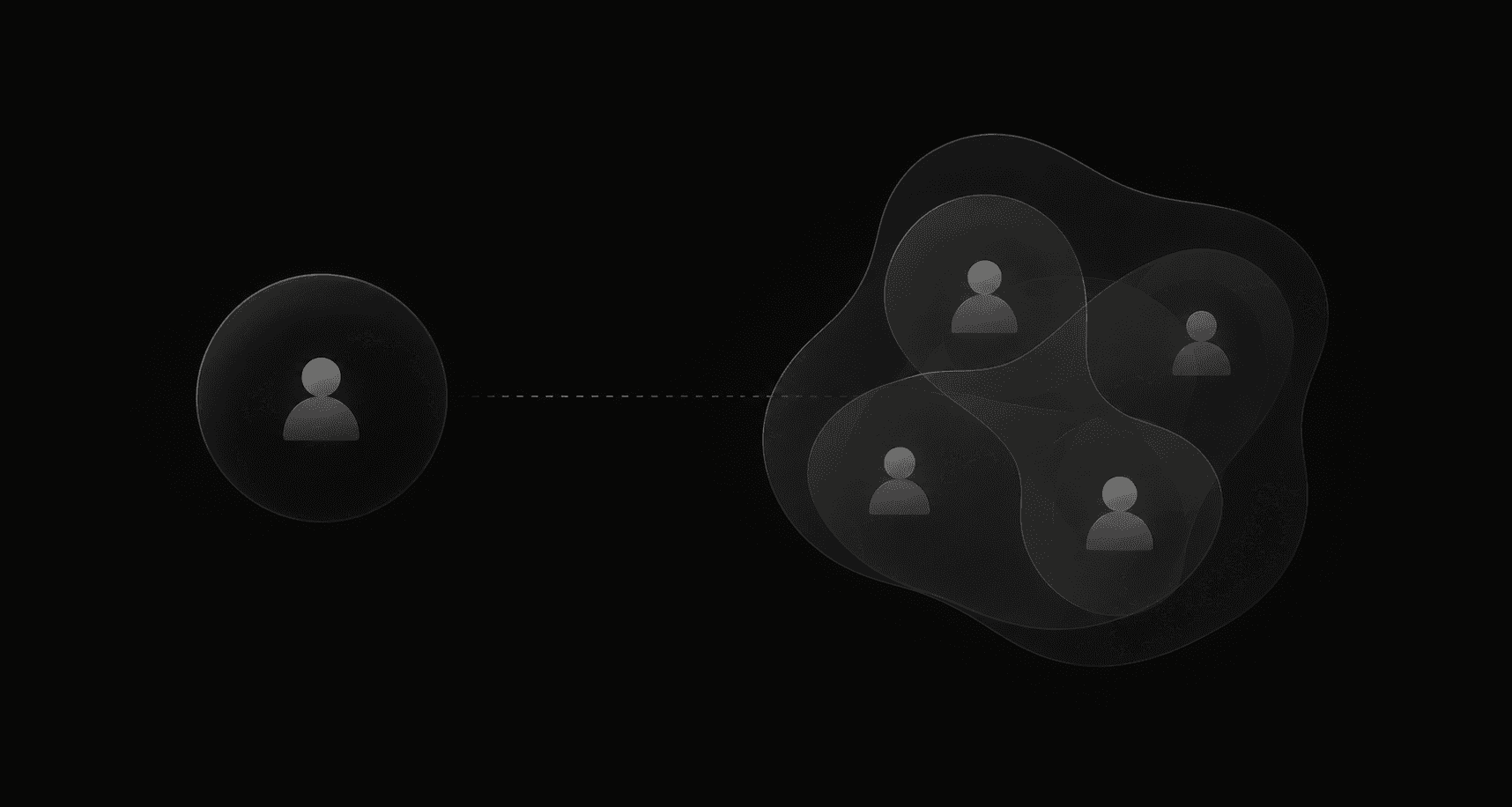
In practice that's less tidy and a fair bit more honest. You hold the persona as a span rather than a point, so that "moderately technical" is understood to run all the way from someone automating things you never built for to someone who needs the safe default to also be the obvious one, both of them yours and both worth designing for. The shape of the research starts to matter more than its middle, the bimodal splits and the long tails especially, because averaging two groups who want opposite things just hands you one imaginary person who wants neither. And mostly it's about letting the people stay plural for as long as you can stand it, resisting the pull to collapse forty conversations into a single ops lead, because the moment they all become Sarah they lose the ability to surprise you, and being surprised was more or less the entire reason you went and talked to them.
Daniels put it roughly like this in his report, that the urge to think in terms of the average man is a trap you fall into easily, and that you almost never find an average person, not because the group is unusual but because variability is simply what people are. He was writing about cockpits, but it reads like a note about customer research, which is most of why I keep going back to it.
Get new field notes delivered
One or two emails a month. Essays like this one, plus the occasional teardown of what we're seeing across customer calls.